Topics / six connected themes
Medicine changes when ideas connect.
Follow six forces that have shaped medicine—from the way bodies were understood to the institutions, evidence, treatments, and ethics that turned knowledge into care.
Change through time
Six eras, one evolving practice
Move from observation and inherited knowledge to experiments, systems, and global responsibility.
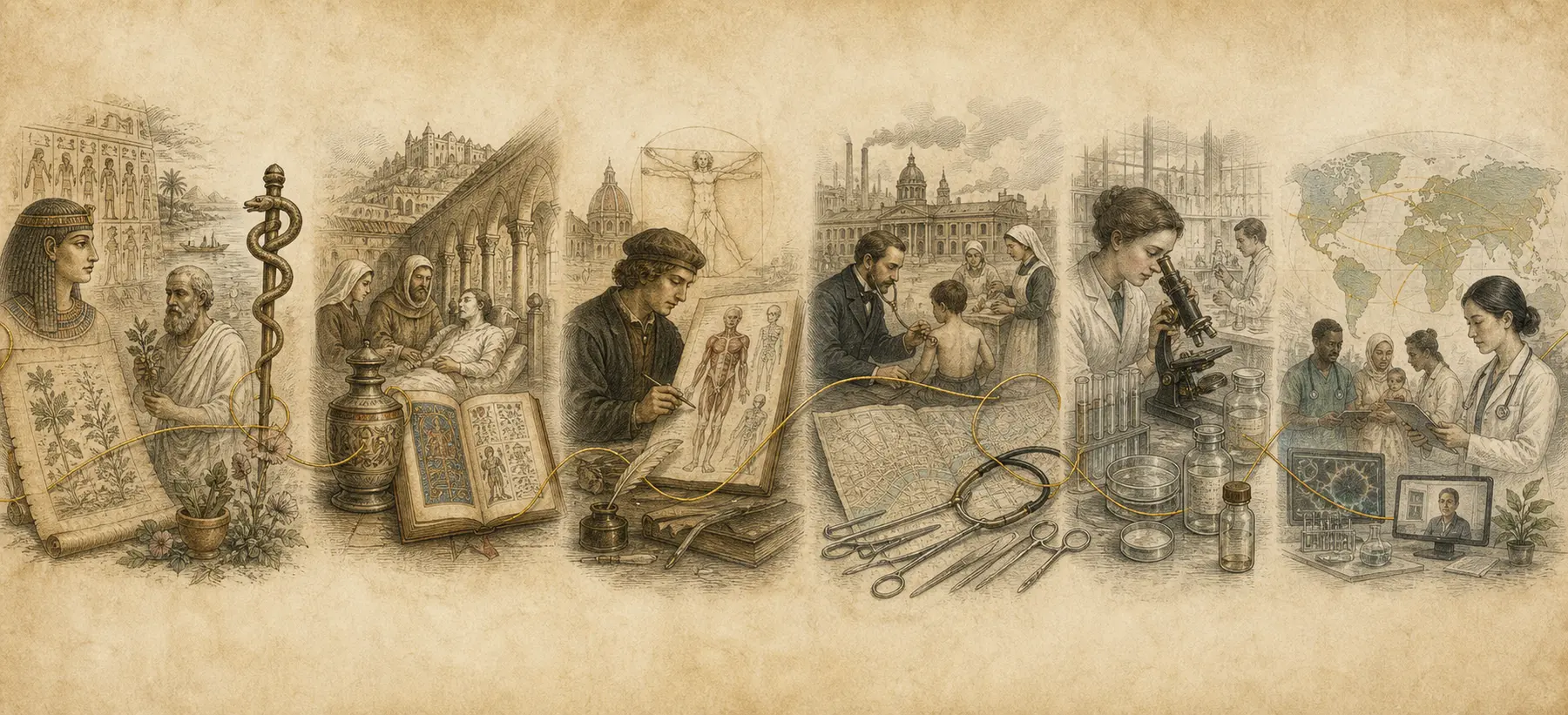
- Ancient foundationsObserve, record, explain
- Networks of learningTranslate, preserve, care
- Anatomy & printOpen, draw, circulate
- Public health & surgeryMeasure, reform, intervene
- Laboratory medicineTest, compare, standardise
- Global systems & ethicsConnect, question, share
The complete collection
Open a theme. Choose a guide.
All 57 guides remain here, grouped by the six relationships shown above.
01Ideas of the body / 7 guidesBodies, theories and diagnosis
How healers described the body, classified illness, examined patients, and made disease legible.
- Ancient Egyptian medicinePapyri, ritual and practical healing
- History of anatomyDissection, structures and the opened body
- History of bedside medicineExamination, diagnosis and clinical teaching
- Mental health and asylumsConfinement, care and institutional reform
- History of psychiatryDiagnosis, treatment and contested authority
- History of pathologyAutopsy, tissue and disease classification
- History of forensic medicineMedical evidence, death and the law
02Populations and prevention / 12 guidesDisease, epidemics and public health
How disease travelled, how populations were measured, and how prevention became a public responsibility.
- Epidemics and public healthPlague, surveillance and intervention
- History of public healthSanitation, prevention and public authority
- History of epidemiologyPatterns, field investigation and surveillance
- Medical quarantine stationsPorts, borders, detention and movement
- The Victorian sanitary movementCities, sewers and public-health reform
- Cholera and John SnowWater, mapping and urban evidence
- History of vaccinationImmunity, trust and mass prevention
- The 1918 influenza pandemicWar, masks, mortality and memory
- History of occupational medicineWorkplace hazards, reform and regulation
- History of tropical medicineVectors, empire and global health
- History of malariaQuinine, mosquitoes and eradication
- History of tuberculosisConsumption, sanatoria and antibiotics
03Intervention and relief / 13 guidesTreatment, surgery and therapeutics
How practitioners intervened in illness, relieved pain, developed medicines, and made surgery safer.
- Surgery through the agesOperative practice, anatomy and risk
- History of anaesthesiaPain control, monitoring and operative care
- Antisepsis and asepsisInfection control and the sterile field
- History of military medicineBattlefield surgery, evacuation and trauma
- History of dentistryExtraction, prosthetics and oral health
- History of blood transfusionBlood groups, storage and emergency care
- Antibiotics and penicillinInfection treatment and resistance
- Pharmacy and apothecariesMedicines, standards and drug safety
- History of herbal medicineRemedies, trade and regulation
- History of medical botanyPhysic gardens, collecting and drugs
- Pain relief and aspirinAnalgesia, toxicity and everyday treatment
- Diabetes and insulinExperiment, access and chronic care
- History of cancer treatmentSurgery, radiation and chemotherapy
04Organising care / 9 guidesInstitutions, care and professions
How hospitals, schools, occupations, and professional boundaries organised medical work.
- History of hospitalsCharity, clinical care and institutions
- History of the hospital wardBeds, rounds, routines and privacy
- History of ambulance servicesEvacuation, dispatch and prehospital care
- History of nursingCare, sanitation and professional practice
- Hospital nursing schoolsTraining, ward labour and reform
- Obstetrics and midwiferyBirth, expertise and maternal health
- History of medical educationUniversities, apprenticeship and science
- History of medical licensingStandards, exclusion and public trust
- Women in medical historyCaregivers, practitioners and barriers
05Making knowledge / 12 guidesInstruments, images and evidence
How tools, records, pictures, laboratories, and collections changed what medicine could see and prove.
- History of medical instrumentsTools, manufacture and clinical authority
- History of the microscopeLenses, slides and visual proof
- Microscopy in medicineCells, tissues and laboratory diagnosis
- Medical imaging through historyX-rays, scanning and diagnostic vision
- History of radiologyRadiation, interpretation and specialist practice
- History of medical illustrationAtlases, photography and representation
- History of medical laboratoriesSpecimens, tests and experimental authority
- History of medical recordsCase notes, privacy and data
- History of medical statisticsMortality, measurement and comparison
- History of clinical trialsComparison, randomisation and ethics
- History of medical librariesManuscripts, indexing and access
- Medical museums and collectionsSpecimens, display, consent and return
06Power and responsibility / 4 guidesSociety, ethics and empire
How medicine defined obligations, travelled through empire, and negotiated religion, humanitarianism, and professional power.
More ways into the collection
Browse beyond subjects.
Follow medical history through institutions, original sources and objects, historical periods, or regions.
Explore the collection